KOPF VERTICAL PIPETTE PULLER MODEL:720
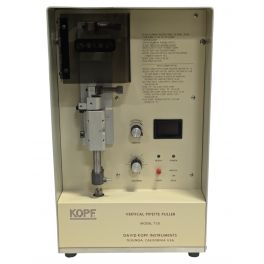
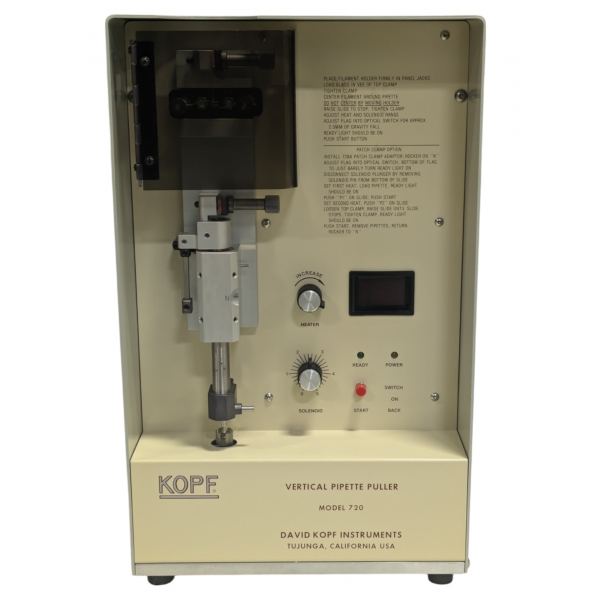
Kopf 720 Vertical Pipette Puller
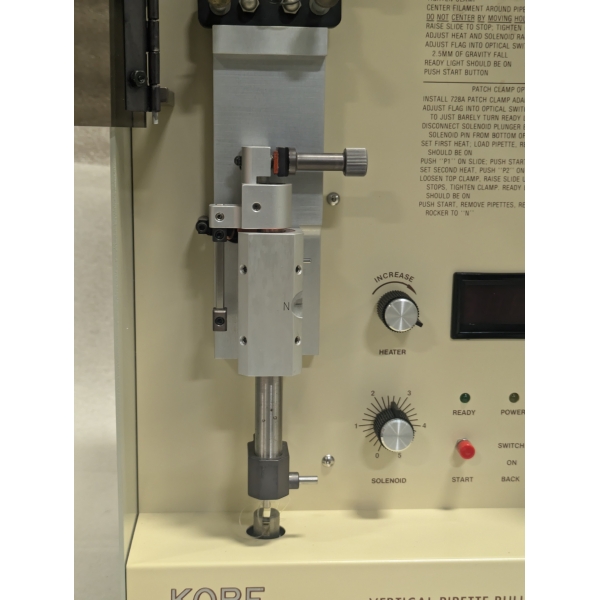
The Kopf 720 Vertical Pipette Puller is easy-to-use, versatile and reliable with excellent reatability. The faceplate protects the heater from drafts to ensure reproducibility. It's small, compact size takes up less than a square foot of bench space. Large tips as well as tips of 0.25 microns or less can be obtained. Pipette glass diameters of 0.4 mm to 3.0 mm, thin as well as heavy walled, can be held and pulled.
The unit pulls pipettes vertically to help assure straight, concentric shapes. In addition, its small,compact size (11" x 9-1/2" x 14-1/2") occupies less than a square foot of bench space. Like all Kopf instruments, the Model 720 is built for reliability and durability and requires little maintenance. The slide mechanism employed is a super accurate component that has been used for more than 35 years on other Kopf vertical pipette pullers.

Reproducibility
The Model 720 will repeatedly pull micropipettes of the configuration for which it has been set.This is possible because of the ability to control the parameters in the pulling sequence and the superb accuracy of the vertical slide mechanism. Small fluctuations in heater temperature can significantly affect the shape of a pipette during the pulling sequence. To help prevent this,the Model 720 is designed to be less susceptible to line voltage changes and therefore provides superior heat regulation. For maximum reproducibility, turn the unit on for a 30-minute warm-up before using. Another factor, which can adversely affect pipette shape, isresidual heat. The 720 helps to eliminate this problem in several ways. The heater turns off theinstant the solenoid is activated and since the unit is of vertical design, any residual heat rises up away from the tips. The use of platinum / iridium filaments further minimize the problemsince the filaments have an extremely low thermal mass and cool very rapidly. Both tips are below the heater filament when the pull is complete.
Glass: The diameter of the glass and wall thickness (O.D. / I.D.) will change the pull time. A change as small as .04 mm O.D. can result in as much as a second difference in pull time. Variations of more than .04 mm O.D. in a single piece of glass have been measured as an out of round condition. Glass within the same batch can vary by more than .08 mm. These variations will affect the pull time and consequently the shape of the pipette. Soda lime glasses containing Na20 have a low heat resistance, a less than desirable chemical stability, and higher conductivity than borosilicate glasses. Lead glasses containing Pb0 have
good hot flow characteristics and high electrical resistivity.
Solenoid force
The force applied in separating the pipettes plays a major role in their shape, particularly
during the draw. A repeatable pull is necessary to make good pipettes. When the glass
reaches a viscous state, the initial pull is first determined by gravity. As the slide falls a preset
distance, an optical switch is activated turning off the heater and turning on the solenoid for
the final pull. The shape of the pipette may be changed by varying the distance at which the
solenoid is activated and the pulling force of the solenoid.
Heater Filaments
Heater filaments variables are temperature, shape and proximity to the glass. Heat and its
distribution along the glass influence pulling time. The higher the temperature, the longer the pipette. Two sizes (1.5 mm and 3.0 mm) of 90% platinum/10% iridium heater filaments and a standard 2.5 turn nichrome heater coil are required as part of the 720 puller.
Platinum/Iridium Heater Filaments - vs - Coils
The major control factor in forming pipettes is heat. It is easier to control the heating of a pipette with a ribbon filament than with a heater coil. One end of the coil has approximately 180° more coil than the other end thereby resulting in uneven heating of the pipette.
A ribbon filament will allow you to form a glass pipette at a lower current and will result in more concentric heating of the pipette. Two conditons that affect the pipette are the width of the filament and the proximity of the filament to the pipette. Awide element gives a longer taper than the narrow element.
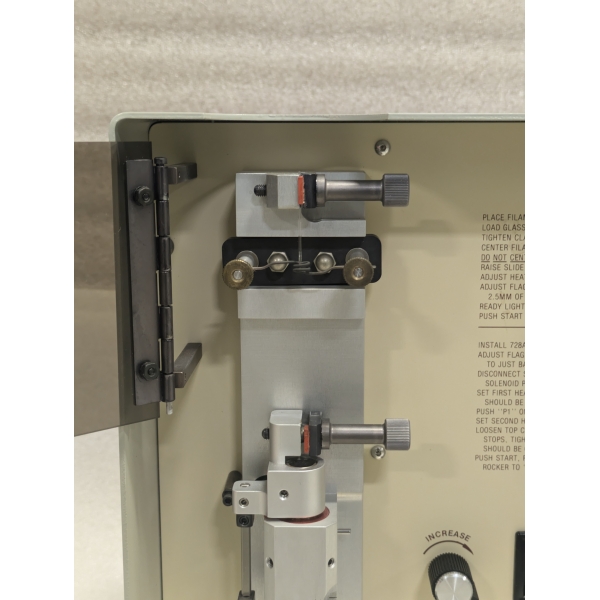
The "U" of the filament needs to be deep enough to allow even heating of the glass (approximately 10 mm deep). The glass should be positioned approximately 1/3 of the way into the loop and equidistant between the sides of the filament. This position will keep the high heat area of the filament curve away from the pipette and allow even heating from the filament sides.
Specifications
⦁ Size: 11"D x 9½"W x 14½"H
⦁ Weight: 29 pounds, 10 ounces
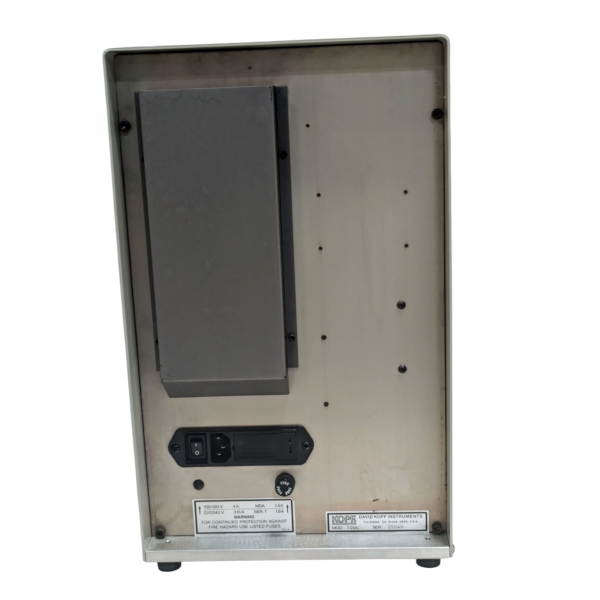
⦁ Input Power: 100/120/220/240 VAC, 50-60 Hz, via rear panel adjustable
⦁ power entry module (comes with appropriate power cord).
⦁ Digital Dispaly: Three digits, adjustable to tenths
⦁ Heater Voltage: 0-19.5 units with resolution of 0.1
⦁ Solenoid Current: 0-5 amps DC regulated.
⦁ Optical Switch: Fixed location with adjustable flags.
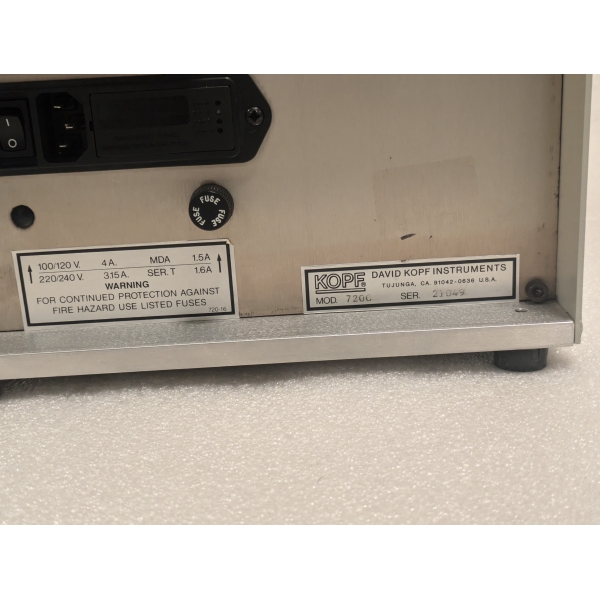
⦁ Fuses: 4 amp (100/120 VAC); 2.15 amp (220/240 VAC); 1.5 amp (11 VAC).
Standard Accessories
⦁ Plug-in Coil Bracket, Model 725
⦁ One Standard 2½ turn Nichrome Heater Coil, Model 710.
⦁ Two Platinum/Iridium Heater Filaments: One 715-16 (1.5 mm) and one 715-31 (3 mm)
⦁ (preformed)
⦁ Fuses: One complete replacement set.
⦁ Pads for upper and lower clamps (may be attached by using Eastman 910 type glue
⦁ i.e., super glue)
⦁ Allen Wrench for Optical Switch and Solenoid Rod.

Pipette Placement in Platinum Filament shown in Heater Bracket

 NeuroLabParts provided us with great quality second hand Patch clamp equipment. The prices were very affordable and the items were almost brand new. Their customer service, maintenance and warranty services were GREAT and they helped us a lot in setting up our lab.
They would even follow up with us for updates on the performance of equipment and are always ......
NeuroLabParts provided us with great quality second hand Patch clamp equipment. The prices were very affordable and the items were almost brand new. Their customer service, maintenance and warranty services were GREAT and they helped us a lot in setting up our lab.
They would even follow up with us for updates on the performance of equipment and are always ......



 Maximize




Follow us